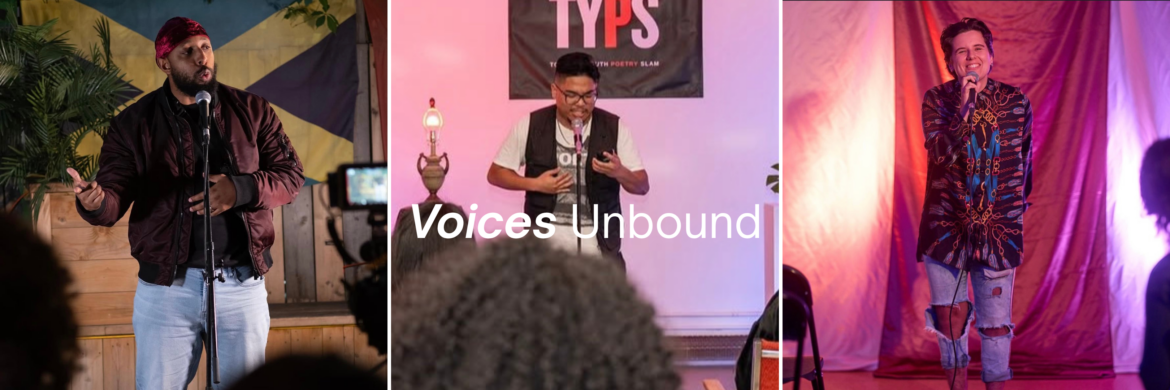
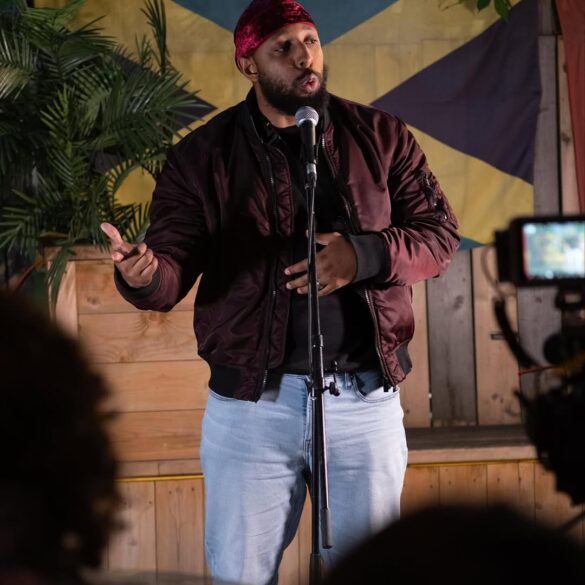
In a bustling city where stories are often reduced to headlines, new voices are finding their way of being heard. Not in editorial offices or council meetings, but under fairy lights, in cafes, unassuming bars and community centres across the GTA.
This is the world of spoken-word poetry, an art form that thrives in the grey areas where language isn’t crafted for print but felt, uttered and shared in the moment. This is where people voice out what they were asked to silence. Where being vulnerable turns into empowerment. Where identity isn’t defined but acted out.
Within the GTA, a new generation of poets, activists and educators is harnessing the power of spoken word to reclaim their voices, particularly those long marginalized by literary and media institutions.
This project explores that movement through four lenses: community, personal storytelling, identity, and education. Together, they provide the framework for the primary question:
What happens when people are finally given the space to speak and are truly heard?
Spoken word is community. Spoken word is inclusivity. Spoken word is accessibility.
Spoken word is voice.
To start, hear my voice in the video below.
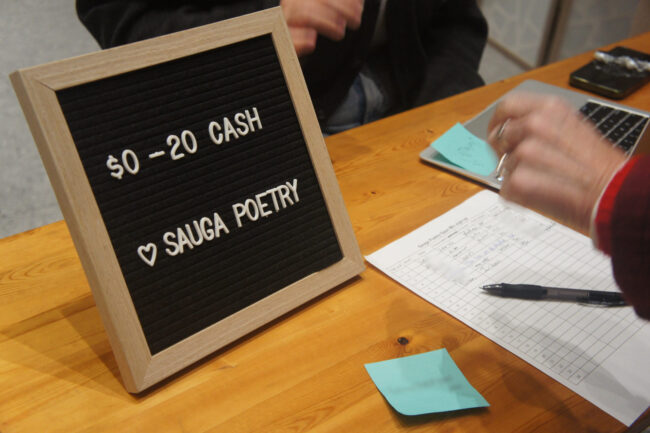
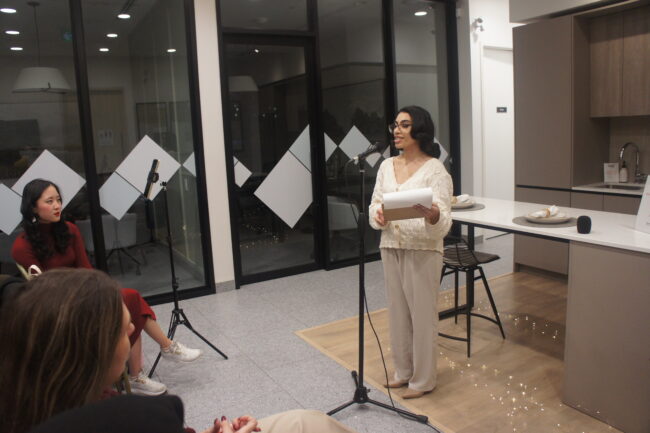
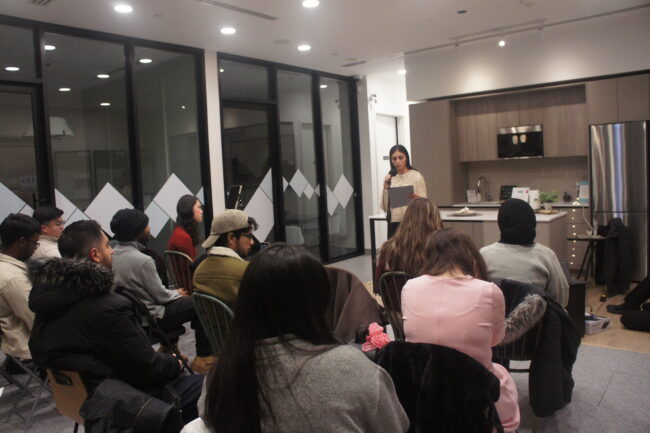
Where the Mic Becomes a Mirror: Inside Mississauga’s Sauga Poetry Open Mic
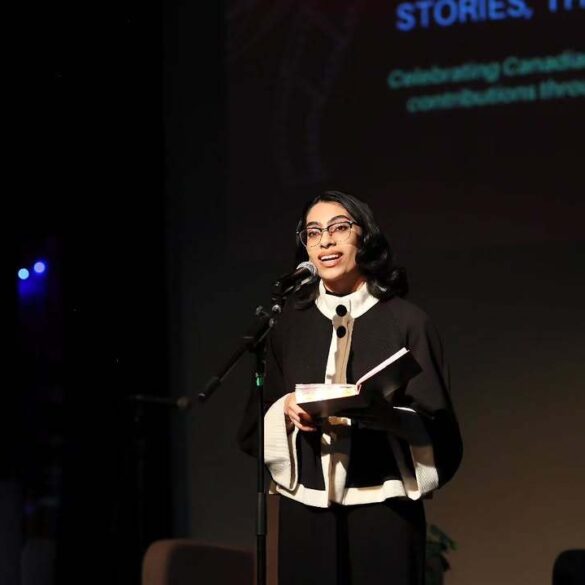
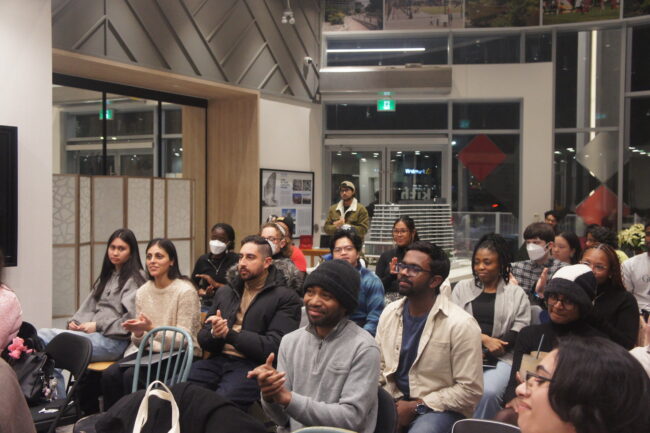
On a cold February night, the room at Sauga Poetry feels anything but distant.
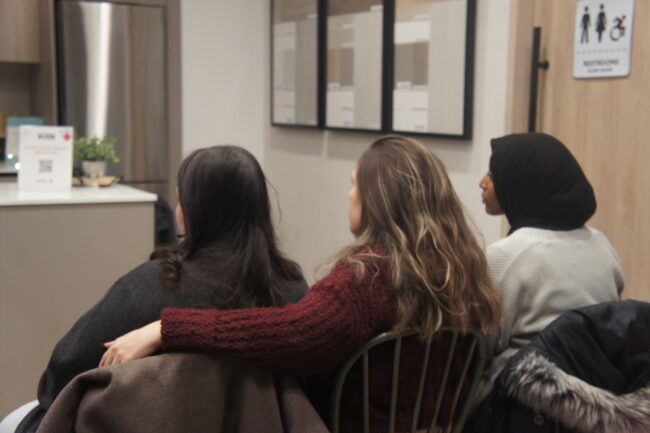
There’s a low hum before the mic opens: quiet conversations, the shuffle of chairs brought in from home, a playlist setting the tone.
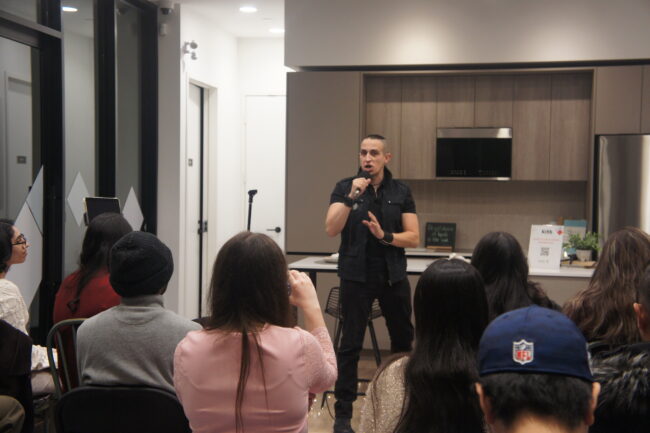
Then, as the first poet steps up, the room shifts. Snaps begin to ripple through the audience. Someone calls out, “Go off, poet.” The energy builds, not just loudly, but collectively, as if everyone is holding space at once.
For spoken word poet Tahira Rajwani, that feeling isn’t accidental. It’s something that’s been built, slowly and intentionally, out of a gap that once defined Mississauga’s spoken-word scene.
Spoken-word poetry is widely recognized as both an artistic and social practice, offering spaces where storytelling, community-building, and activism intersect.
Building something that didn’t exist
Sauga Poetry began in 2023, founded by then Mississauga Youth Poet Laureate Lisa Shen, who recognized a problem that many emerging poets in the city shared: there was nowhere local to go.
Research from The Spoken Word Project shows that access to local arts spaces is critical for participation, as barriers like distance and cost often prevent emerging artists from engaging in creative communities. But that space wasn’t always available outside of Toronto.
“There was a real lack of infrastructure for it,” Rajwani said. While Toronto offered multiple open mics and slam spaces, Mississauga didn’t. “We ended up having to do these two, two-and-a-half hour commutes out to Toronto in order to really develop our skill and find our community.”
For youth, especially, that barrier meant many voices never made it to a stage at all.
When Rajwani stepped into the role of Mississauga’s Youth Poet Laureate and eventually director of Sauga Poetry, she saw firsthand what was at stake. After a hiatus, she brought the series back, not just as an event, but as a necessary space.
A room that feels like home
What Sauga Poetry offers is simple in theory, but difficult in practice: a room where people feel like they belong.
“I definitely think I want them to feel at home,” Rajwani said. “I want them to feel like it’s a warm, welcoming atmosphere … that there is space for them here.”
That feeling starts with small details – lighting, music, the overall vibe the guests and performers brought into the room –but Rajwani is quick to point out that the vibe doesn’t come from the organizer alone.
“It’s really the regulars that come out to every Sauga Poetry event that form the community,” she said. “They make those connections. They make other people feel welcome.”
By the time of the Feb. 22 open mic, that sense of community had taken hold.
Scholars Natalie Alvarez and Jack Mearns found that spoken-word performance creates a reciprocal relationship between poet and audience, where vulnerability from one invites openness from the other.
A night of vulnerability
At Sauga Poetry, the room didn’t just feel welcoming, it felt open.
“I think people were just so supportive,” Rajwani said. “If people are vulnerable, then the audience is supportive of that, and other people feel more comfortable to be vulnerable.”
Poets shared deeply personal pieces, stories of heartbreak, identity, spirituality, and global conflict. Some who hadn’t planned to perform found themselves signing up during the break.
“They felt like, you know what, I’m safe here. My work is safe here,” Rajwani said.
Moments like that are difficult to engineer, but easy to recognize once they happen. A feature performer from Newfoundland, Chukky Ibe, helped set the tone, his presence filling the room with energy, encouraging others to respond, to snap, to speak back to the stage.
“When you have someone like that … it really makes everyone else feel more comfortable to also get into the piece,” Rajwani said.
The result was a night where no single narrative dominated. Instead, everything coexisted.
A space without a niche
Part of what makes Sauga Poetry distinct is precisely that lack of structure.
In Toronto, spoken-word spaces often develop identities, queer-focused, competitive slam-heavy, or centred on specific themes. But in Mississauga, Sauga Poetry operates differently.
“There’s no niche,” Rajwani said. “Everyone who has anything to say comes here.”
That openness creates unpredictability and, with it, a kind of curiosity.
“You don’t know what to expect next,” Rajwani said. “And that’s what makes it interesting.”
Why spoken word matters here
For Rajwani, spoken-word’s power, especially for marginalized communities, is rooted in its history.
“It was a genre crafted specifically for them,” she said, referring to racialized and marginalized voices who have historically been excluded from traditional literary spaces.
Where written poetry often carries barriers of access and form, spoken word offers something else entirely: immediacy, accessibility and voice.
“When you give them spoken word, you are telling them that this is a form of storytelling that is just as valid,” she says.
It’s also why the work often leans toward both the personal and the political.
“You’ll see people talking about systemic racism and colonialism using their own experiences,” Rajwani explained. “It’s not just ‘down with the system’, it’s ‘my grandmother forgot how to speak her mother tongue.’”
These stories, she says, are what create connection, not through abstraction, but through lived experience.
But Sauga Poetry isn’t only a space for protest.
“You have these really powerful, angry pieces,” Rajwani said, “but you also have so much softness and compassion.”
That range, from social justice to heartbreak, is what defines the room.
“It’s just the fundamental human experience,” she said.
Growth in real time
Over time, Rajwani has seen the impact of Sauga Poetry take shape in tangible ways.
Before Sauga Poetry, the city struggled to attract applicants for its Poet Laureate positions. Not because talent didn’t exist, but because community didn’t.
“When people lack community, they lack confidence,” she said.
Now, that’s changing.
“We had significantly more applications than we ever have before.”
Many of those applicants came directly from the Sauga Poetry community, poets who had found their voice in the room and felt ready to step into something larger.
“It’s a network that keeps expanding,” Rajwani said.
Still, building that kind of space comes with challenges.
Sauga Poetry operates as a community-driven, largely volunteer-run initiative. Funding is inconsistent, and sustainability is a constant concern.
“I don’t make profit,” Rajwani said. “This is all volunteer time.”
Even basic logistics, like venue costs or chairs, become shared responsibilities. The series runs on a pay-what-you-can model, prioritizing accessibility over guaranteed income.
“We’re constantly relying on our community,” she said. “If you have foldable chairs … bring them.” And they do.
If Sauga Poetry succeeds, it’s not because of a single person or system, it’s because of the people who keep showing up.
“They show up unapologetically themselves,” Rajwani said.
That presence: repeated, consistent, collective, is what turns an event into a community.
If Sauga Poetry is the room — the container — then the next question becomes:
What happens when someone finally steps into that space and speaks?
Finding language for what felt unspeakable and learning to take up space
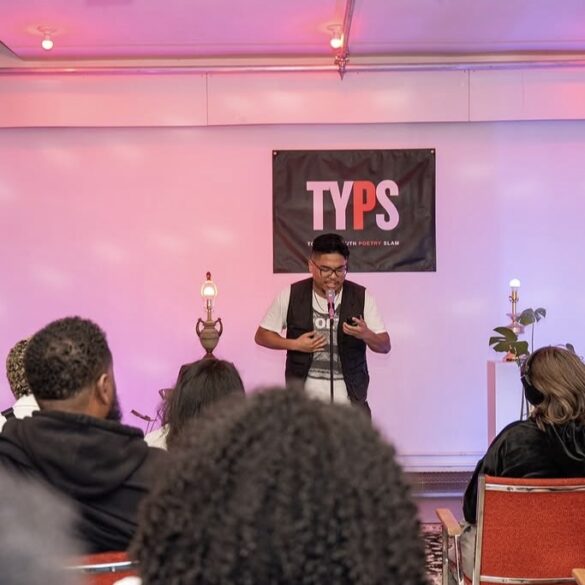
The first time Matthew Reyes stepped onto a poetry-slam stage, his mind wasn’t focused on rhythm or delivery, he was yearning. Trying to find someone, anyone, to hear and understand him.
“I was at a time in my life where I wanted so badly to be acknowledged, validated and understood for who I was and what I represented,” the 23-year-old Mississauga poet said. “My biggest fear was that my poetry wouldn’t resonate with the crowd.”
Instead, the exact opposite happened. Reyes remembers the sound first. The quiet hum of approval that builds in spoken-word spaces, the mmm’s, the snaps, the cheers, the excitement of the crowd was evident. Then the realization hit him.
In that moment, he understood that his poetry belonged in that space, and that he belonged with it.
Alvarez and Mearns also found spoken word performance spaces can create immediate validation and belonging, as audience feedback plays a key role in affirming identity and voice.
“I have heard that my first poem received an average score of 9.9 out of 10 by five judges,” he said, adding that to him this was more confirmation of something greater.
“I was shocked to realize I could move mountains with metaphors. That I could touch souls with soliloquies,” said Reyes.
For Reyes, spoken word isn’t about the score and the performance, it’s about connection, even when he never expects it.
He recalls performing a poem titled ‘Time Loop,’ a performance he personally felt fell short. The judges agreed, scoring him lower than usual. But afterward, someone in the audience approached him.
“She told me I was her favourite performer of the night. She told me not to listen to the judges, that my poem was a raw representation of the realities of adult life,” he said. “It’s not always about impressing everyone. It’s about changing the life of one person in the crowd.”
That kind of impact is rooted in the risks Reyes takes on the stage, particularly when it comes to speaking about mental health.
“Speaking about my mental health in a stripped-back and candid way outside of my poetry is difficult. When I’m on the stage, I am kind of having an out of body experience where what I’m saying doesn’t really feel real. It’s a moment in time that only exists in that space. Also, poetry slams are therapeutic because it’s a space where although you are judged for your poetry, you aren’t judged for what you go through,” he said.
“In the real world, there is so much stigmatization behind mental health that it deters me from wanting to speak about it.”
On stage, that fear transforms. Putting those experiences into poetry becomes both personal release and public awareness.
“It feels cathartic. It’s not about doing it for everyone else. It’s about it doing it for me.”
A study of the effects of spoken-word poetry on mental health shows that poetry serves as a useful means of emotion regulation, stress relief, and fostering a feeling of belonging through shared experiences. It’s not only a form of expression – it can improve mental health.
That release, that expression, is shaped by Reyes’ identity.
“Identity is everything. Even if what I’m performing isn’t directly centred on it, it’s through my identity that my observations and perceptions are changed.”
His ethnicity, experiences and mental health journey, all inform how he writes, and how audiences receive him. But when it comes to “truth,” Reyes is mindful of the word.
“The only truth I tell is my truth. My experiences, my past, my trauma — that’s the one thing that can’t be invalidated.”
That commitment to personal truth reached a turning point in a 2023 performance of a poem titled ‘Ode,’ where Reyes detailed his experience with a nurse who invalidated his depression.
“I don’t think I ever evoked so much emotion into a performance. I truly wore my heart on my sleeve,” he said.
Spaces like Sauga Poetry are where that vulnerability becomes possible. He describes it as an environment “all about the art, rather than competition.”
“It’s a warm, cozy environment where everyone can share their experiences free of judgement.”
For newcomers, he added, it offers an entry point that feels accessible, a contrast to the high-pressure structure of a competitive slam.
Still, Reyes is clear that spoken word doesn’t erase fear, it reshapes it.
“I feel exactly the same. The nerves, the adrenaline, the jitters. The only part that’s changed is my perspective,” he said.
Instead of resisting those emotions, he’s learned to accept them as part of the craft.
The process, however, exists within a shifting landscape. Before the pandemic, Reyes says, there were more entry points into the spoken word community. Now, between funding challenges and broader structural changes, the opportunities have narrowed, even as the scene begins to slowly rebuild.
“There has been a slight resurgence, but it’s not the same as before,” he noted.
Reyes also believes the power of spoken word remains widely misunderstood.
“Spoken word is so much deeper and more complex and beautiful than social media has portrayed it to be,” he said.
Reflecting on those who have yet to experience performing spoken word firsthand, Reyes offers this insight:
“Don’t worry about what others are thinking. Focus on yourself. Focus on how you want to convey your message, and just take that step.”
For the young poet, the performance has nothing to do with perfection; it is all about being there, in the moment, and maybe just having one person who is actually really, really listening.
If Reyes’ story shows what happens when voice is found then the next layer to explore is:
What happens when that voice is shaped by identity: by queerness, spirituality and the body itself?
Poetry as portal: Angelic Goldsky on voice, power and becoming
There are some people who speak like they are still discovering the sentence while saying it, like language is something alive, something moving through them in real-time.
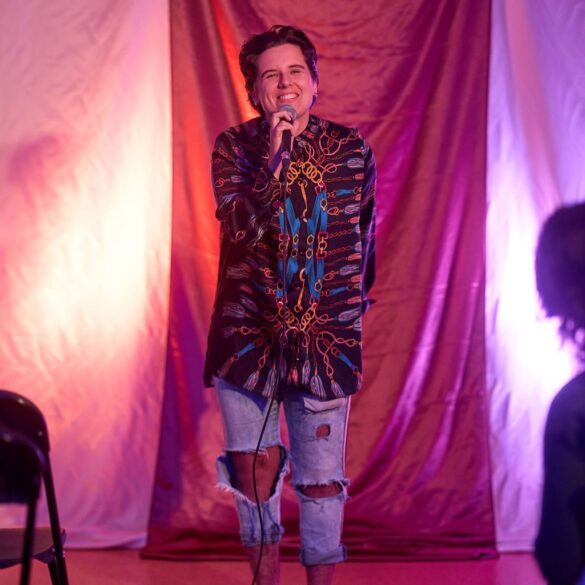
Angelic Goldsky is one of those people.
They don’t begin with a clean definition of who they are. Instead, they circle it, through memory, through rhythm, through fragments of self that feel just as important as the whole.
“Poetry has definitely been my life since I was five,” they said. “I wouldn’t even call it writing. I was stealing the rhymes from the Arthur cartoon.”
That instinct, to borrow, to play, to reshape language, never really left. It just evolved.
Goldsky describes themself as many things: poet, facilitator, educator, multi-disciplinary artist. But poetry is the constant, the thread that holds everything together.
“It’s always this backbone of poetry,” they said. “That kind of lives with everything that I do.”
Before Toronto, there was Vancouver. A poetry slam scene that didn’t just teach them the craft, it helped them grow up.
“I feel like the spoken word scene in Canada really raised me.”
They started performing at 13. By the time they were older, they were running slam teams, producing shows, building spaces where poetry wasn’t just performed, it was experienced.
And then, before identity had language, there was a house.
A “slammily house.” Basement drag poetry parties. A group of people creating something before they fully understood what they were creating.
“We all just were throwing these drag poetry basement-party shows and then we just kind of realized, ‘Oh my God, we’re all gay.’”
Now based in Toronto, Goldsky’s work has expanded, across performance, education and research.
At OCAD, they’re exploring something that feels both ancient and experimental: the intersection of Jewish prayer, queerness, performance and technology.
“Thinking about … what’s sacred, what’s profane … how are some things both?”
The question sits at the centre of their practice, not just academically, but artistically. Because for Goldsky, poetry isn’t just expression. It’s transformation.
“I feel like poetry kind of offers a space of transcendence,” they said.
Not escape, but movement through.
Their work often begins in places that feel heavy: trauma, unsafety, memory. But it doesn’t end there.
“It’s this moment of healing and repair and soul-level restoration.”
That’s the intention. That the act of speaking something, fully, honestly, can shift it. Can return something to the body that wasn’t there before.
“And so when I perform that, it’s my hope that that radiates to other people.”
But what gets said, and what doesn’t, still depends on the room.
Goldsky speaks openly about the tension between expression and acceptability, especially as a queer and trans artist.
“I feel like my truest self, there’s some vulgarness there that is not palpable for the majority of family friendly, straight audiences.”
Because sometimes, poetry isn’t gentle. Sometimes it wrestles.
“In Judaism, we consider ourselves God wrestlers. I really like this idea of wrestling, showing this kind of playful and sometimes transgressive aggression.”
And in that tension between confrontation and joy, something else emerges. Euphoria. Ecstasy. Permission. Still, poetry doesn’t always arrive at something tangible.
Goldsky describes their process less like writing, and more like solving something that doesn’t yet exist.
“It feels almost kind of like a math equation,” they say. “Everything just lines up. The rhythms are right. The syllables, everything.”
Sometimes that takes years.
“I’ll be performing a poem and every time I perform it, it’s like a reiteration.”
Until, one day, it lands.
“And I’m just like, ‘Oh yeah, this is it.’”
When that happens, the thinking disappears. The body takes over.
“It’s just an embodiment of something now.”
Research from the National Council of Teachers of English in the United States shows that when poetry is taught and shared in community, it doesn’t just shape individual voices, it builds confidence, identity, and agency through collective expression.
As a facilitator, Goldsky has seen that same transformation happen in others, often in moments that feel small, but aren’t.
Workshops with children. With elders. With people navigating language barriers. Rooms where not everyone understands each other, but everyone understands something.
They remember one moment in particular. A field in Montreal. Three participants. An exercise built around a simple phrase: I am.
“We were chanting these ‘I am’ poems … jumping and running … there was this sort of feeling of just freedom.”
Different languages. Different lives. Same release and outcome.
“It wasn’t even as if all of us understood each other, but it was just this sort of flow.”
For Goldsky, that’s the work. Creating containers where people can access something they didn’t know they were allowed to feel, or say.
“Sometimes people just remember that they’re a badass,” said Goldsky.
And when it comes back to them, to their own relationship with poetry, the answer is simple, but not easy.
“I feel like a part of me is missing without it.”
Poetry is where conversations happen. With the self. With others. With memory. With something beyond language.
“It gives me a space to understand my life,” they said.
To process. To archive. To reconnect.
“To be real with myself and real with these people that I have something to say to.”
Because the truth is, someone is listening, even if you don’t see them.
“People have come up to me and been like, that really changed my life … and I’d be like, ‘No it didn’t,’” said Goldsky.
But it did.
“And then I remember … those people are actually telling the truth.”
So the work becomes bigger than the person doing it.
“It’s not even about you sharing your voice sometimes,” they said. “It’s about … the world needs to hear it.”
And somewhere, whether it’s three people, or three hundred, someone will.
“You never know who’s out there listening.”
If Goldsky’’s work expands what voice can look like, then the final question becomes:
What happens when that voice is passed on, taught, nurtured and shared with the next generation?
Spoken word is power: Scribe on giving marginalized youth a voice in Toronto
For Joshua “Scribe” Watkis, spoken word is not just an art form, it is a tool. A practice. A method of survival and, more importantly, a way to teach others how to be heard.
A Scarborough-born poet, educator and mentor, Scribe has spent more than a decade working across Canada, building a career that exists both on stage and in classrooms. His work today sits at the intersection of performance and pedagogy, where poetry becomes less about performance alone and more about what it unlocks in others.
“My work, being a spoken-word artist as well as a hip-hop artist and an arts educator … it’s been about 14 years … doing performances and going across Canada, and especially southern Ontario,” he said.
“Right now, my work is mostly centered on arts education, mentoring young poets and helping them to learn about spoken word and, more importantly, to learn about their own voices and their own feelings through the spoken word.”
While his artistic work continues to explore personal and political realities, from race and class to fatherhood, his focus has shifted toward impact. Toward what happens when spoken word is placed in the hands of young people who have not traditionally been given the space to speak.
Spoken word as access
At its core, Scribe frames spoken word as one of the most accessible forms of storytelling available, a form that removes barriers rather than reinforcing them.
“Anybody can share a spoken-word poem so long as they know how to speak … you don’t even need the ability to write. If you can memorize your words and say your words to yourself and form a poem out of them, that gives you access,” he said.
In a landscape where traditional poetry and literary spaces often require a certain level of literacy, education or institutional access, spoken word offers a different entry point: one rooted in voice, not validation.
“It doesn’t even require a high level of literacy to participate … not to be great, not to excel in the form, but to participate. And when you give people room to participate, it becomes a form that’s more easy to engage with.”
That accessibility, he explains, is not a limitation of the form, but its strength. It allows people to enter the space as they are, without needing permission.
A form rooted in culture and history
Beyond accessibility, Scribe situates spoken word within a broader historical and cultural lineage, one that predates written poetry altogether.
“It’s more culturally connected than most other forms of poetry. If you go around the world prior to European colonization, more cultures used the spoken word or oration or oral tradition as a means of passing on information,” he said. “When you take into account the fact that historically, human beings used oral tradition more than the written word, it also gives access to different styles and traditions and patterns globally.”
In that sense, spoken word is not new, it is a continuation. A return to something that has always existed, especially within marginalized and racialized communities whose histories were often carried through voice rather than text.
A changing scene and shrinking space
Having been part of the spoken-word scene for over a decade, Scribe has seen firsthand how the landscape in Toronto and the GTA has shifted, not necessarily in terms of talent or interest, but in terms of infrastructure.
“I think the community has experienced waves of coming and going, not everybody is using spoken word as something that’s going to be a long-term tool professionally,” Scribe said.
But more significantly, he points to external forces, particularly gentrification and the aftermath of the pandemic, as key factors shaping the current state of the scene.
“What’s more affected the scene … is the infrastructure of Toronto changing … we experienced a lot of business closure and gentrification … and those things remove venues for the arts. They remove access in terms of where can we host a space in the city?” he said.
As spaces disappear, so too do opportunities for emerging artists to grow organically within their own communities.
“Only people with kind of legacy power and continued funding get to last. There’s not much room for organic growth,” he said.
What shifts when youth find their voice
In classrooms and workshops, however, Scribe sees a different kind of growth — one that is immediate, visible and deeply transformative.
“Oh, absolutely … the confidence that people have … exponentially increases. The ability to articulate and advocate for oneself … exponentially increases,” he said.
For many young people, especially those from marginalized backgrounds, spoken word becomes the first space where their voice is not only heard, but valued.
“People who may not have been in the position to assume leadership suddenly kind of see the value of their thoughts and their ideas,” he said. “Most of the students I’ve been privileged to mentor … at some point go into their community and become agents of change in their own right,” he said.
What begins as self-expression often evolves into something larger: leadership, advocacy and community-building.
For students who do not see themselves reflected in traditional academic spaces, spoken word offers something even more radical: autonomy.
“They get to carve it out for themselves … the ability to say, ‘I’m here and you’re going to listen to me for the next two to three minutes’ is already more than most marginalized students are going to receive,” he said.
In systems that often offer limited agency, spoken word flips the dynamic. It does not ask for representation, it creates it.
“They themselves are the people speaking. They’re not looking for representation. They are the representation,” he said.
Why it resonates with marginalized communities
Scribe is clear: spoken word’s impact on marginalized communities is not accidental, it is foundational.
“If you grew up in an immigrant household … one of the things you were kind of taught is to keep your head down … not ruffle feathers … but when you have the ability to face that, that feels like power,” he said.
And for youth in particular, that power is often something they have never been given before.
“We live in a society where children are oppressed … kids can’t vote. Kids can’t make decisions about their own lives … they get very little agency,” he said. “So for them to flock to a form … that’s the first time they get to have autonomy, to take up space, to have their own power and to be seen properly.”
The role of vulnerability and why it must be shared
Like all art, spoken word relies on vulnerability, but what sets it apart is the immediacy of sharing that vulnerability in a room full of people.
“Vulnerability in spoken word is the same as vulnerability in any other art form, it’s a requirement for the human experience to be connected to it,” Scribe said.
He points to the idea that art allows people to see themselves reflected in others — to recognize that they are not alone:
“It’s giving other people the opportunity to see themselves inside of you.”
And the act of sharing — of performing — is what transforms that connection into something collective.
“The spoken word was made to be heard … to do it in a space with another person is what gives it its social power … and its ability to bring about impact,” he said.
Even when asked to imagine a world without spoken word, Scribe resists the premise — because for him, voice itself is inherent:
“If we exist, the spoken word exists.”
The form may evolve, shift, or take on different names — but the need to speak, to tell stories, to be heard, will always find a way through.
“We would have found ways … rap exists because spoken word exists… preachers preach… we would have found ways,” he said.
Because at its core, spoken word is not just about poetry. It is about voice.
And who gets to use it.
AI was used in this project to assist with transcription, research support and grammar.